Grafana dashboard catalog
A complete map of the DefenseClaw Grafana dashboards, who each board is for, which telemetry rail it uses, how drill-downs connect, and how to interpret empty panels.
DefenseClaw provisions a focused catalog of 16 Grafana dashboards. Each board has one job: start broad, select a connector, agent, rule, or execution, and then move to the detail surface that owns that question. The catalog avoids duplicating the same analysis across several boards.
Start here
Platform overview
Health, guardrails, findings, errors, and the links into every specialist board.
Live agent activity
Cross-agent prompts, model usage, tools, destinations, and session correlation.
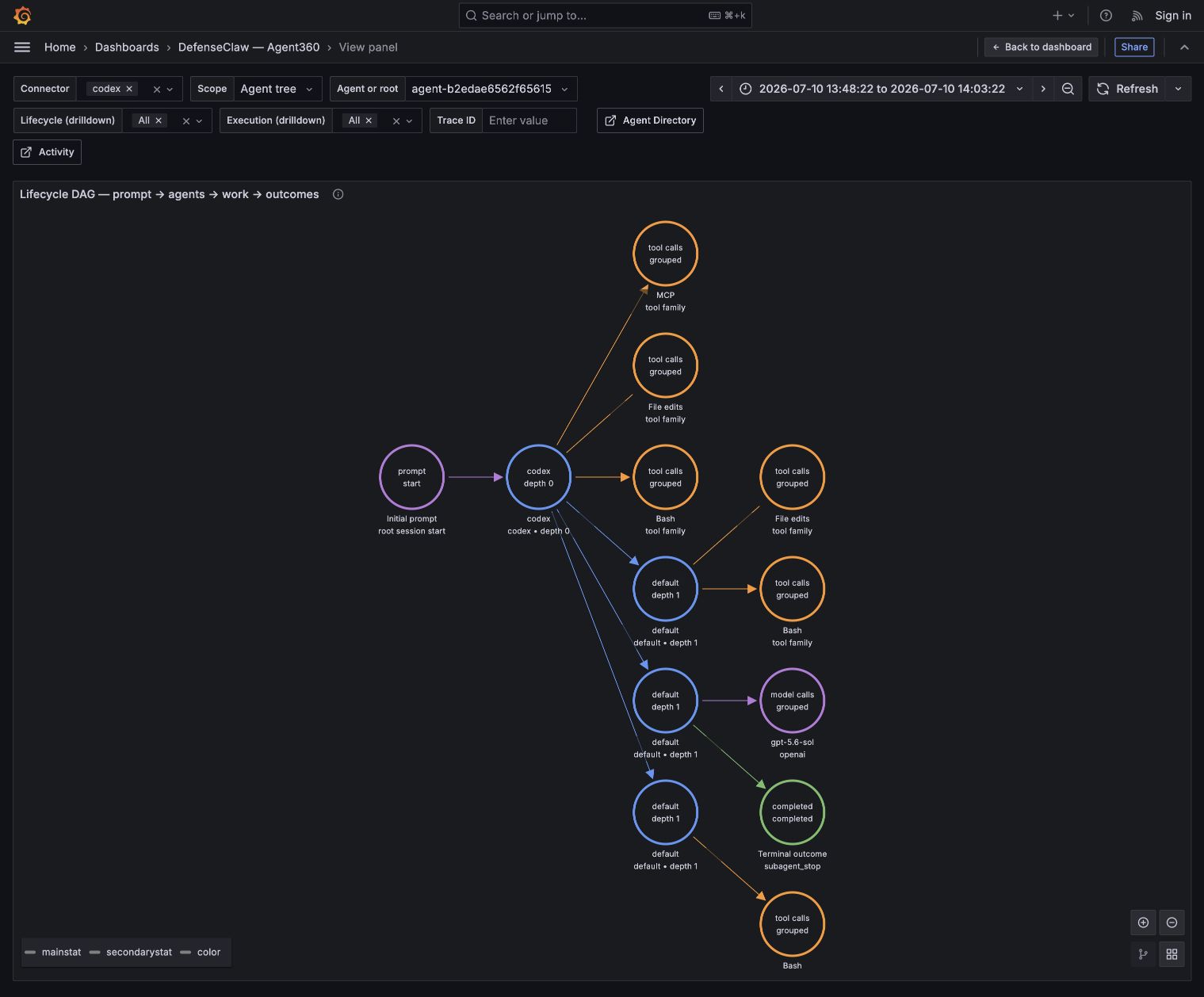
Agent360
One agent or tree: initial and follow-up prompts, grouped per-agent model/tool work, directed lineage, outcomes, decisions, and traces.
Blocked Events & Analysis
Enforced and would-block decisions, exact rule IDs, post-redaction evidence, recurring signatures, and investigation pivots.
Runtime & reliability
Process, SQLite, exporter, audit-sink, and canonical error health in one operations board.
Complete inventory
| Dashboard (UID) | Primary question | Audience | Signals | Why it exists |
|---|---|---|---|---|
Overview (defenseclaw-overview) | Is DefenseClaw healthy and enforcing as expected? | Operator, SOC, SRE | Prometheus, Loki | The landing board: KPIs, SLOs, guardrail outcomes, findings, errors, and links to owned detail views. |
Agent Activity (Live) (defenseclaw-activity) | What are agents doing across the selected time range? | Developer, incident responder | Prometheus, Loki | Cross-agent prompt → model → tool → destination flow and session correlation. Finding, discovery, topology, and pipeline duplicates intentionally live elsewhere. |
Agent identity (defenseclaw-agent-identity) | Which logical agents and instances have been observed? | AI platform, inventory owner | Prometheus, Loki | Runtime Agent Directory, identity confidence, instance churn, and the one-click entry into Agent360. |
Agent360 (defenseclaw-agent-360) | What happened inside this agent, execution, or full descendant tree? | Developer, SOC, AI platform | Prometheus, Loki, Tempo | The deepest correlated drill-down: lifecycle phases, initial/grouped follow-up prompts, decisions and recovery, tokens, cost, network activity, per-agent provider/model and tool-family summaries, and trace waterfall. |
Blocked Events & Analysis (defenseclaw-blocked-events) | What was blocked, which rules drove it, and which events recur? | SOC, policy owner, incident responder | Prometheus, Loki | Enforced versus observe-mode decisions, all exported verdict rule IDs, projected tool context, exact recurring signatures, and correlation pivots into Agent360, Findings, and Policy Decisions. |
AI Agent Usage & Detection (defenseclaw-ai-discovery) | Which AI products, skills, MCP servers, and dependencies exist? | Asset owner, security | Prometheus, Loki, Tempo | Continuous discovery inventory, confidence, detector health, and scan traces. |
Hook Connectors (defenseclaw-connectors) | Which connectors are active, quiet, slow, or drifting? | Operator, integration owner | Prometheus, Loki | Cross-connector comparison and the route into Connector Detail. |
Connector Detail (defenseclaw-connector-detail) | Why is one connector behaving differently? | Integration owner | Prometheus, Loki | Connector-scoped hooks, latency, outcomes, tokens, findings, and recent events. |
Guardrail Evaluations (defenseclaw-security) | What did guardrails allow, alert, confirm, or block? | SOC, policy owner | Prometheus, Loki | Verdict funnel, severity, latency, connector comparison, and raw decision detail. |
Policy decisions (defenseclaw-policy-decisions) | Which policy or egress branch caused the action? | Policy owner, SOC | Prometheus, Loki | Decision and network-egress analysis, including observe-mode would-block outcomes. |
HITL (defenseclaw-hitl) | Where did a human approval enter the flow, and what was the outcome? | Approver, SOC | Prometheus, Loki | Chat and execution approval funnels plus the corresponding event stream. |
Findings (defenseclaw-findings) | Which rule fired, against what target, and how often? | Detection engineer, SOC | Prometheus, Loki | Rule-level ranking, first/last seen, target attribution, and finding-to-verdict correlation. |
Scanners (Ops) (defenseclaw-scanners) | Are scanner executions healthy and producing expected findings? | Detection engineer, SRE | Prometheus | Sparse-safe rolling scan counts, duration, errors, quarantine actions, and operational finding trends. Queue depth is omitted because scanners currently execute synchronously and do not emit a durable queue series. |
Proxy & LLM Guard (defenseclaw-traffic) | What is happening on proxy/router deployments? | Proxy operator, SRE | Prometheus, Loki, Tempo | HTTP, tool, guardrail, GenAI, and trace telemetry that only exists when proxy/router mode is active. |
Runtime & Reliability (defenseclaw-runtime) | Is the local process, database, exporter, or audit pipeline unhealthy? | SRE, operator | Prometheus, Loki | One truthful operations board for runtime, SQLite, exporter freshness/errors, audit delivery, and gateway errors. |
Retain, consolidate, and remove decisions
- Retain the 16 boards above. Each owns a distinct operator question or a deliberate overview → detail drill-down; none is a renamed duplicate.
- Runtime and Reliability stay consolidated. The former standalone Reliability dashboard duplicated process/exporter panels and has been retired from both fresh installs and upgrades.
- Scanners no longer shows queue depth. Scanner execution is synchronous today and the queue instrument has no producer, so that panel could never truthfully populate. Rolling scan count/duration panels remain because they are backed by emitted counters and histograms.
- Proxy & LLM Guard and HITL are conditional, not broken. Proxy panels need proxy/router mode; chat/execution approval panels need those approval paths. They remain separate because combining them with always-on hook telemetry would obscure which enforcement surface generated the event.
- Agent Activity and Agent360 intentionally differ. Activity answers cross-agent “what is happening now?” questions; Agent360 owns one selected agent/execution, recovery path, topology, and trace waterfall.
The old standalone Reliability board was consolidated into Runtime & Reliability. Panels that merely relabeled goroutines or exporter errors as queue depth, panics, configuration errors, or circuit state were removed; a zero from an unrelated metric is more dangerous than an honest absence.
How the drill-down works
flowchart LR
  O[Overview] --> C[Hook Connectors]
  C --> CD[Connector Detail]
  O --> A[Agent Activity]
  O --> I[Agent identity]
  I --> A360[Agent360]
  A360 --> T[Tempo trace waterfall]
  O --> G[Guardrail Evaluations]
  G --> P[Policy decisions]
  G --> H[HITL]
  O --> S[Scanners]
  S --> F[Findings]
  O --> R[Runtime & Reliability]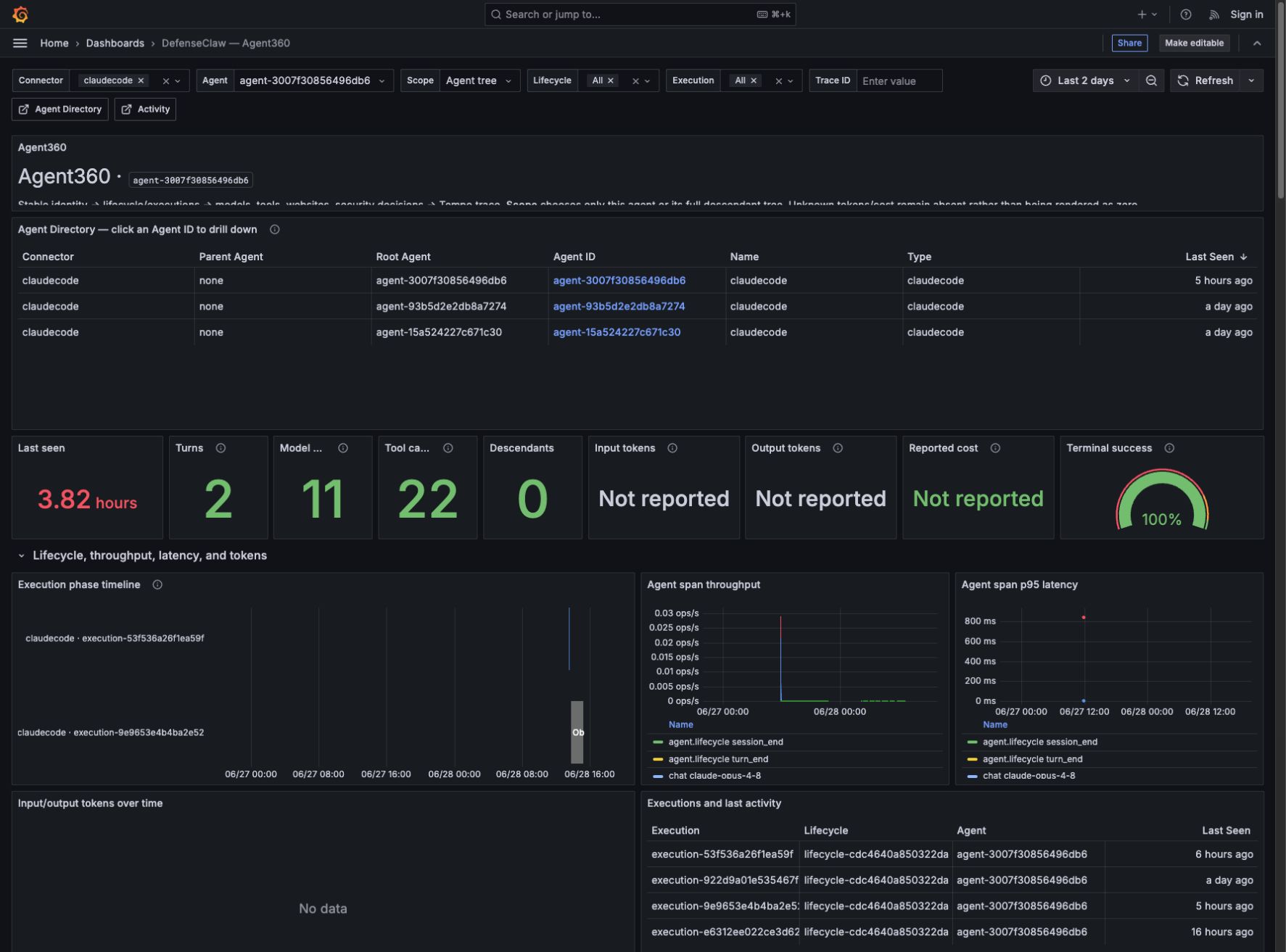
Agent and trace identifiers are rendered as direct data links. Selecting an
Agent ID preserves the time range and opens the reusable Agent360 board.
Selecting a Trace ID sets the trace variable on the same dashboard and
populates the Tempo waterfall without losing the connector, agent, lifecycle,
or execution filters.
The Agent360 lifecycle DAG is also interactive. Clicking a node or edge exposes
its total count, grouping key, available lineage, session, lifecycle/execution,
sequence, operation/call, outcome, connector, and trace fields plus
time-range-preserving drill-down links. Session and durable lineage anchors may
use the prior 24 hours to keep selected-range boundary edges renderable; a
recovered lineage edge appears only when that child has graph-eligible activity
in the selected range. Agent parentage comes only from active typed parent_of
or inverse delegated_by relationship records, never a raw parent field or trace
parentage.
Repeated model calls are summarized per
owning agent, provider, and model. Tool calls are summarized per owning agent as
Bash, MCP, Skills, Collaboration, File edits, Web/browser, Visual, or Task control;
an unrecognized tool keeps its reported name. Exact
collaboration.send_message requests are excluded from the generic
Collaboration summary and appear only as message groups; other collaboration tools
remain in that family. Filtered links retain access to every exact raw canonical
OTEL record. Stable agent nodes use agent/root/parent identity, name, type, depth,
and connector; optional session fields stay in lifecycle/session/ordered/raw
detail rather than splitting totals. One per-root Prompt inputs node counts distinct
depth-zero model.request facts, deduplicated by turn, model-request, request,
operation, then occurrence identity; the ordered/raw views retain the individual
initial and follow-up records. Session start stays
a distinct lifecycle anchor and is not mislabeled as prompt content. Real
collaboration.send_message updates to /root or /root/* collapse into
one Messages to root node per sender, resolving the exported root agent ID
while exact paths/calls remain in ordered/raw drill-downs. Non-root targets remain
exact groups without fabricating an agent-ID edge.
Which backend owns each answer
| Backend | Best for | Dashboard behavior |
|---|---|---|
| Prometheus | Totals, rates, quantiles, current state, inventory | Counter totals use the selected range, so a completed gateway run remains visible even when it is no longer exporting. |
| Loki | Lifecycle DAG, cross-request chronology, inputs/outputs, commands, reasons, decisions, ordered recovery | Empty means no matching event occurred in the selected range and filters. |
| Tempo | One request-bounded operation and its parent/child span timing | Trace panels populate only after selecting a valid Trace ID or when matching spans exist. |
The dashboards do not apply their own masking, redaction, or field hiding. DefenseClaw centrally redacts before canonical OTEL export, and Grafana displays or links every field present in the received projection, including content when the producer supplies it. It cannot recover a field removed or transformed before export.
Read empty values correctly
DefenseClaw does not invent telemetry.
| Display | Meaning |
|---|---|
| 0 | The signal is instrumented and the selected range contains zero matching events. |
| No data | The panel is conditional (for example HITL, failures, or proxy-only traffic) and no matching series or event exists for the current filters. |
| Not reported | The connector/provider did not report that field, most commonly token usage or cost. It is not equivalent to zero. |
If a global panel is unexpectedly empty while raw events are visible, widen the time range first. Historical token totals and model/provider breakdowns use range functions, so they continue to render after the gateway process stops. Then run the syntax/datasource audit:
python scripts/check_grafana_dashboards.py --liveFor a panel-by-panel data inventory over the last 48 hours, run:
python scripts/check_grafana_dashboards.py --inventory --inventory-hours 48The inventory reports Data, Zero, Empty, Interactive, Static,
and Error separately for every dashboard. Static panels are intentional
text/instructions. It uses the representative codex
connector and all agent IDs: connector-detail queries exercise a real
single-selection value, while trace waterfalls that need an explicit agent or
trace selection are classified as interactive instead of broken.
The live audit checks Grafana health and asks Prometheus, Loki, and Tempo to parse every retained query. Conditional panels may return no rows, but malformed queries, missing datasources, empty dashboard rows, dangling drill-down links, stale packaged copies, and instant-only historical token queries fail the audit.
The standalone command works in a pristine source checkout before generated
CLI data exists. make check first generates the CLI mirror and then runs the
same audit with --require-packaged, making source/package drift a required CI
failure.
Source of truth and upgrades
Dashboard JSON is owned by
bundles/local_observability_stack/grafana/dashboards/ and copied into the CLI
package by make _bundle-data. defenseclaw setup local-observability up
refreshes the host-mounted stack by default, so upgrades pick up removed,
renamed, and corrected dashboards. Use --no-refresh-config only when you
intentionally preserve operator-edited local files.
Local observability stack
One-command OpenTelemetry + Loki + Tempo + Prometheus + Grafana stack, pre-wired to the DefenseClaw gateway. Grafana on :3000, dashboards seeded, no manual config.
Agent360 dashboard
Drill from any observed agent into lifecycle, executions, model and tool activity, tokens, cost, security decisions, hook enforcement/recovery paths, traces, and agent topology.