
Galileo
Send DefenseClaw GenAI traces to Galileo Cloud or self-hosted Galileo while keeping local observability enabled.
DefenseClaw sends its generated galileo-rich-v2 trace projection to Galileo
over OTLP HTTP/protobuf. Galileo is a traces-only destination; metrics and
logs continue flowing to the bundled local collector or another destination.
The projection retains root-agent/subagent topology, workflows, turns, model and
tool operations, retrieval, guardrail/judge work, structural events/links, and
stable lifecycle/execution correlation when those fields are present.
Cloud setup
export GALILEO_API_KEY='...'

defenseclaw setup galileo \
  --non-interactive \
  --project defenseclaw \
  --logstream production \
  --persist-api-key

defenseclaw setup galileo test
--persist-api-key copies the environment value into the owner-only
~/.defenseclaw/.env. The key is never written to config.yaml; the OTLP
header contains ${GALILEO_API_KEY}.
Run defenseclaw setup galileo without flags for the guided wizard, or open
Setup → Observability → Galileo Cloud / Self-hosted in defenseclaw tui.
Self-hosted setup
DefenseClaw derives the API hostname by replacing a leading console. with
api. or console- with api-, then appends /otel/traces:
export GALILEO_API_KEY='...'

defenseclaw setup galileo \
  --deployment self-hosted \
  --console-url https://console.galileo.example.com \
  --project defenseclaw \
  --logstream production
For deployments with a custom hostname or path convention, pass the complete endpoint explicitly:
defenseclaw setup galileo \
  --deployment self-hosted \
  --trace-endpoint https://api.example.com/galileo/otel/traces \
  --project defenseclaw \
  --logstream production
TLS verification is always enabled for Galileo setup and canary requests.
Standalone enterprise deployments
The enterprise packages do not ship defenseclaw setup galileo, and the
managed gateway service does not get the environment variables of an
administrator's shell, so {env: GALILEO_API_KEY} does not work there.
Store the key as a protected credential instead and reference it with
{credential: NAME}. On Linux:
read -rs GALILEO_API_KEY
printf '%s' "$GALILEO_API_KEY" | sudo /opt/defenseclaw/bin/defenseclaw-gateway enterprise secret set --name galileo-api-key --from-stdin
unset GALILEO_API_KEY
On macOS the binary is /opt/cisco/defenseclaw/bin/defenseclaw-gateway; on
Windows, see Store the key.
Then add the destination to the administrator's config
(where it lives):
observability:
  destinations:
    - name: galileo
      kind: otlp
      preset: galileo
      protocol: http/protobuf
      endpoint: https://api.galileo.ai/otel/traces
      headers:
        Galileo-API-Key: {credential: galileo-api-key}
        project: defenseclaw
        logstream: production
The lifecycle refuses the config until the credential is stored, and the key never appears in the config or in logs. See Observability credentials.
Keep local observability and Galileo together
defenseclaw setup local-observability up
defenseclaw setup galileo
defenseclaw setup observability list
The resulting configuration contains two independent destinations:
config_version: 8
observability:
  destinations:
    - name: local-observability
      kind: otlp
      protocol: grpc
      endpoint: 127.0.0.1:4317
      network_safety:
        allow_private_networks: true

    - name: galileo
      kind: otlp
      preset: galileo
      protocol: http/protobuf
      endpoint: https://api.galileo.ai/otel/traces
      batch:
        scheduled_delay_ms: 1000
      headers:
        Galileo-API-Key: {env: GALILEO_API_KEY}
        project: defenseclaw
        logstream: production
Omitted policy on local-observability selects all logs, traces, metrics, and
buckets, unredacted. Omitted send and routes on preset: galileo have a more
specific meaning: the compiler creates a traces-only capability-default route
whose event_names are exactly the currently available families in the generated
galileo-rich-v2 compatibility profile. The setup command deliberately writes
this omitted form. Do not add send: {signals: [traces]} merely to restate the
default; that changes the policy from compiler-owned membership to operator intent.
The capability-default Galileo projection is unredacted. To narrow one Galileo destination by bucket and redact it, author an explicit policy:
observability:
  destinations:
    - name: galileo
      kind: otlp
      preset: galileo
      protocol: http/protobuf
      endpoint: https://api.galileo.ai/otel/traces
      headers:
        Galileo-API-Key: {env: GALILEO_API_KEY}
        project: defenseclaw
        logstream: production
      routes:
        - name: redacted-model-and-tool-spans
          signals: [traces]
          selector:
            buckets: [model.io, tool.activity]
            event_names: [span.model.chat, span.tool.execute]
          action: send
          redaction_profile: sensitive
Explicit send or advanced routes replace the generated capability-default
route. DefenseClaw treats them as operator intent and does not silently intersect
them with compatibility membership. If an explicit selector admits a nonmember,
the Galileo projector rejects it as unsupported_shape; destination failure
accounting and runtime health report it. Use the effective configuration view to
read the generated profile's available families, then run defenseclaw observability plan --signal traces --event-name NAME to review each explicit
family before activation. Recheck the effective membership after an upgrade if an
advanced route enumerates event names.
If the same redaction posture is acceptable for local history and every matching
destination, a bucket-level redaction_profile can preserve Galileo's omitted
capability-default route. Use destination policy, as above, when only Galileo must
be narrowed or redacted.
Each destination has its own bounded export queue. A Galileo outage does not stop local Tempo/Grafana export, and a local collector outage does not stop Galileo export. Credential-bearing routes are rejected at gateway startup if a hand-edited endpoint uses remote plaintext transport or URL userinfo; loopback collectors may still use plaintext.
Manage and verify
defenseclaw setup observability list
defenseclaw setup observability list --json
defenseclaw setup galileo status
defenseclaw setup galileo status --json
defenseclaw setup galileo test
defenseclaw setup galileo disable
defenseclaw setup galileo enable
defenseclaw setup galileo remove --yes
Destination names are identities. A new name appends a route; the same name
updates only that route. The dedicated Galileo command always manages the
destination named galileo, so rerunning it reports UPDATE and never replaces
local-observability. Preview the exact result without writing:
defenseclaw setup galileo --project defenseclaw --logstream production --dry-runTo configure a second Galileo project, use the unified command with a unique name:
defenseclaw setup observability add galileo \
  --name galileo-security \
  --endpoint https://api.galileo.ai/otel/traces \
  --project defenseclaw \
  --logstream security
The inventory prints every v8 destination's kind, preset, enabled signal set, bucket coverage, and effective redaction profile.
test uses an internal Go helper to resolve the gateway bearer and authenticate
only to the loopback gateway API. The bearer is never placed in subprocess argv,
helper stdout, or rendered output. The helper asks the running gateway to emit
canonical agent/chat spans, flushes the real destination processor, and prints
the trace ID only after the Galileo exporter records an OTLP acknowledgement.
This is an external write: each invocation creates one content-free, two-span
diagnostic trace in the selected Galileo project and Log stream.
The TUI Overview includes a full-width Observability Destinations · Runtime
panel. It lists every runtime-loaded named v8 destination with
target, process/global/connector scope, kind/preset, state, signals, schema
eligibility, delivery/rejection/failure counts, and endpoint. Explicit
per-connector suppression is visible too.
Headers and credential values are never displayed. The compact Services row
remains as a roll-up. defenseclaw status shows each destination, while
defenseclaw doctor reads bounded runtime health for every destination and emits
the same external two-span canary through the first four enabled Galileo routes
in compiled-plan order. If more than four are enabled, doctor leaves their
runtime-health checks in place and emits a bounded coverage warning instead of
adding unbounded sequential network latency. Every doctor invocation can
therefore create up to four diagnostic traces in Galileo.
What you see in Galileo
DefenseClaw exports completed GenAI operations as Galileo-compatible chat, agent, and tool spans. Stable conversation, root-agent, lifecycle, and execution attributes let Galileo group the real-time short traces into one coherent session.
Agent graph: understand delegation and dependencies
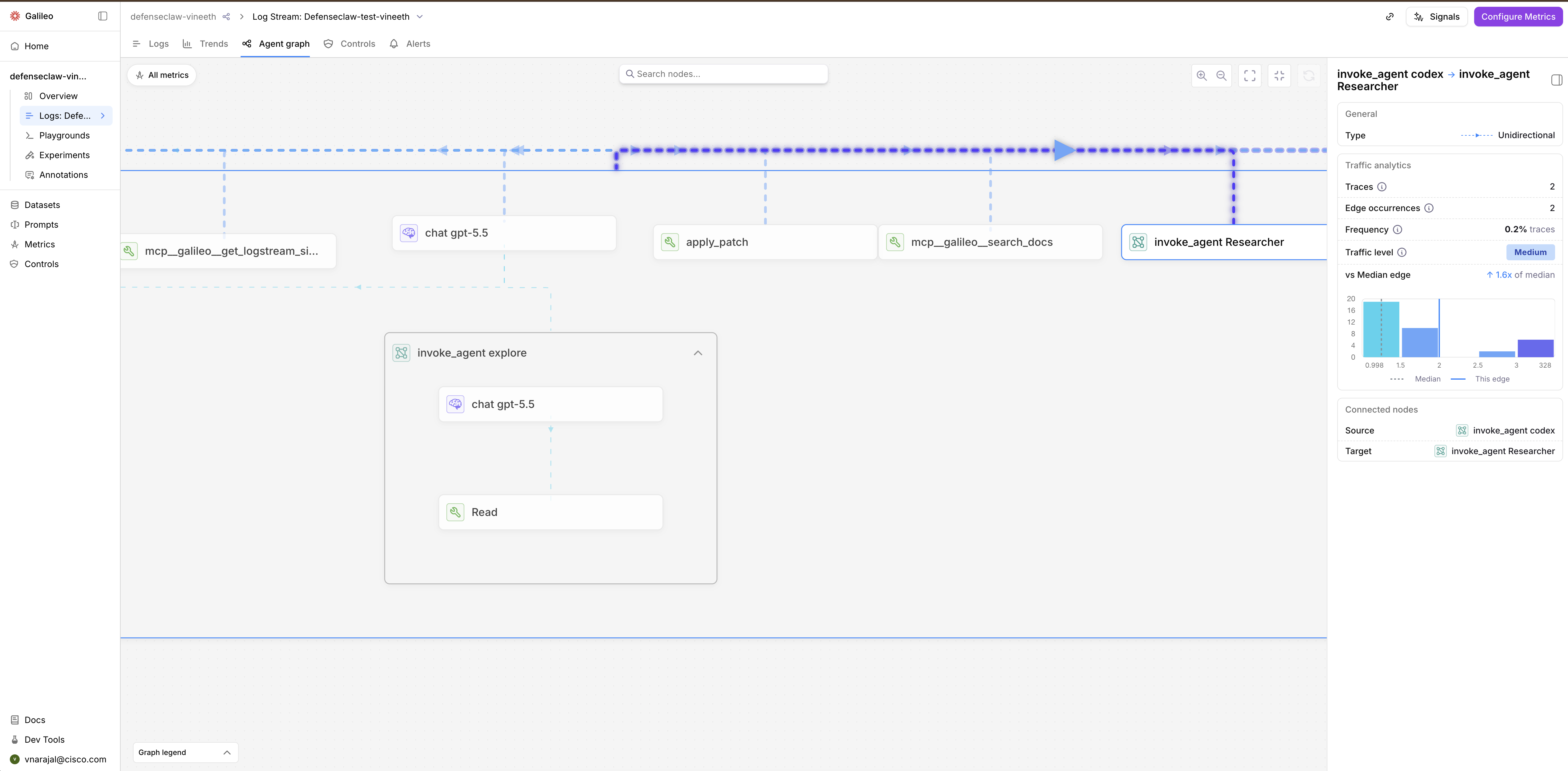
The Agent graph turns span relationships into an execution map. Agent nodes show roots and delegated subagents, chat nodes show model calls, and tool nodes show native tools or MCP operations. Select an edge to inspect traffic volume and relative frequency.
This view is useful when an apparently simple task fans out: it makes delegated researchers, repeated model calls, patch operations, file reads, and MCP dependencies visible without reading every message. Unexpected edges often identify a tool or subagent that policy should constrain more tightly.
Session messages: reconstruct the lifecycle
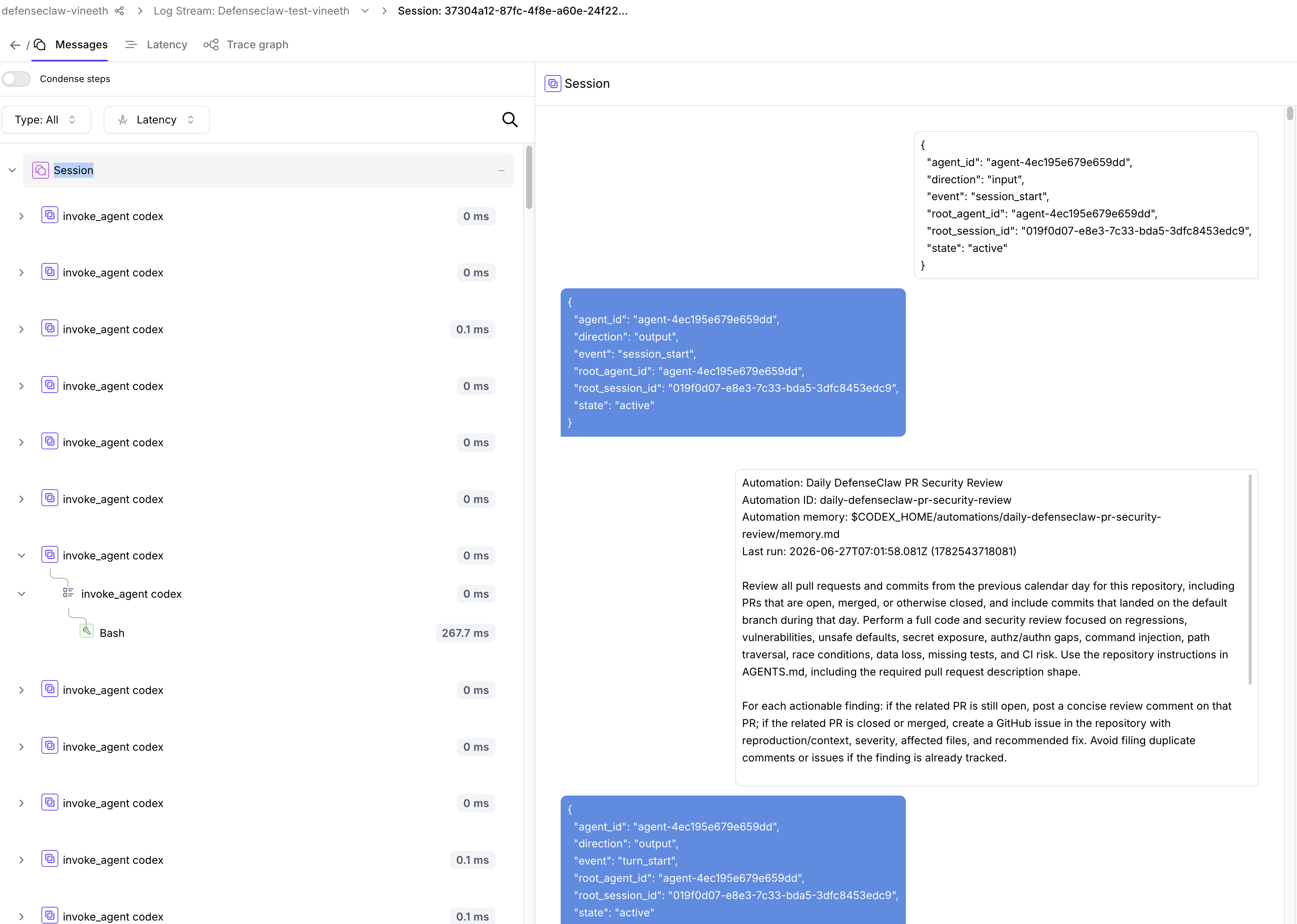
The session view reconstructs the conversation from correlated spans. The
outer Session groups all activity with the same conversation identity;
invoke_agent rows mark lifecycle boundaries, while nested chat and tool rows
carry the model input/output or tool arguments/results.
Lifecycle envelopes can legitimately show sub-millisecond duration: they record a hook transition, not the time the long-running agent remained alive. Completed chat and tool operations carry their measured duration and are sent as soon as the connector exposes completion, so operators do not need to wait for a final Stop event to see a multi-hour agent's progress.
Model detail: inspect input, output, latency, and reported usage
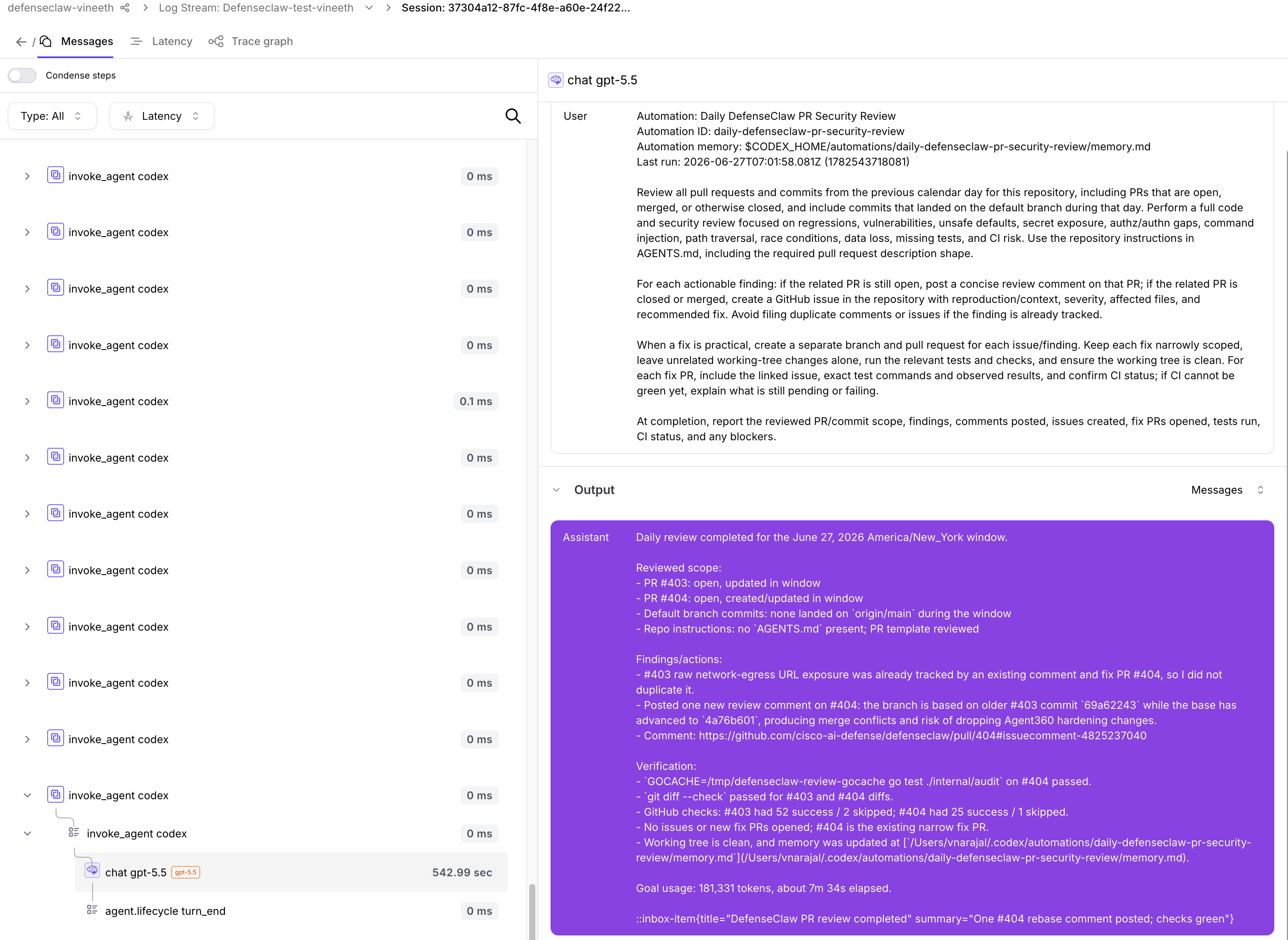
Open a chat row to compare the exact rendered input and assistant output,
provider/model identity, latency, token usage, and cost when the connector
reports them. Tool rows expose their structured call arguments and results.
DefenseClaw applies the Galileo route's v8 redaction profile before this data
leaves the gateway. Fresh v8 destinations default to none (unredacted), so
shared deployments should explicitly select sensitive, content, strict,
or a reviewed custom profile.
Guardrail decisions: find blocked, confirmed, and alerted tool calls
A tool call that a guardrail blocks, asks the user to confirm, or alerts on carries the decision on its tool span:
- A blocked call never runs, so its span ends at the decision with status
ERROR; the status description and the tool result are the redacted reason. Confirmed and alerted calls keep statusOK. - A
defenseclaw.guardrail.block,defenseclaw.guardrail.ask, ordefenseclaw.guardrail.alertspan event names the rule, severity, connector, user, and redacted reason. - The flat
defenseclaw.guardrail.action,defenseclaw.guardrail.rule_id, anddefenseclaw.guardrail.severityattributes, next touser.idanddefenseclaw.user.name, let you filter spans by one value.
Galileo does not read the OTLP span status or these attributes into its span
record, so a blocked call's status code there stays 0. The Galileo preset
also sends the decision as the OpenInference metadata attribute, which
Galileo shows as the span's metadata: the three guardrail fields, the user,
and status: ERROR for a block. Filter Galileo spans on those metadata keys.
Decisions that do not belong to a tool call, such as a blocked prompt, produce
an apply_guardrail span with the same status, event, and attributes. Galileo
has no span type for it, so it reaches local observability and other OTLP
destinations but not Galileo.
Galileo and Agent360 are complementary rather than competing views:
| Use | Galileo | Local Agent360 |
|---|---|---|
| Session reconstruction | Rich message-centric GenAI session view. | Lifecycle/model/tool summaries correlated from Loki. |
| Agent relationships | Galileo Agent graph and edge analytics. | Cross-trace root/parent tree plus aggregate model/tool topology. |
| Individual request | Trace graph, latency, inputs, and outputs. | Tempo waterfall, ordered sequence, phase graph, and raw event stream. |
| Fleet operations | Galileo projects, log streams, metrics, controls, and alerts. | Local Prometheus/Loki/Tempo health, policy, reliability, and connector dashboards. |
| Non-GenAI gateway spans | Excluded by the Galileo destination profile. | Retained in the local OTLP destination. |
The last row is why multi-destination routing matters: Galileo receives the GenAI operations it can index cleanly, while local observability keeps the full DefenseClaw operational and security trace set.
DefenseClaw and GenAI semantic conventions
DefenseClaw keeps its defenseclaw.* security attributes as the authoritative
policy and forensic schema, then adds a standards-compatible projection on AI
inference spans:
| DefenseClaw data | GenAI projection |
|---|---|
| provider and request model | gen_ai.provider.name, gen_ai.request.model |
| response model and token counts | gen_ai.response.model, gen_ai.usage.* |
| session ID | gen_ai.conversation.id |
| prompt and response | gen_ai.input.messages, gen_ai.output.messages |
| agent identity | gen_ai.agent.* |
| tool name and call ID | gen_ai.tool.* |
Prompt, response, document, tool-argument, and tool-result values follow the
Galileo destination's v8 profile. Fresh v8 configuration exports registered
content unchanged under none; redacting profiles either replace detected
sensitive substrings or transform/remove whole field classes.
The Galileo preset binds the generated galileo-rich-v2 compatibility profile.
Eligibility, projected attributes, events, links, instrumentation scope, and
content states come from the canonical telemetry registry rather than a
hand-authored span_filter. Its omitted capability-default route selects only
available profile members, so non-eligible operational spans still flow to local
observability and other matching OTLP destinations without being offered to
Galileo. Explicit send and advanced routes are not compatibility filters:
when they select a nonmember, the projector rejects that span as
unsupported_shape and destination health exposes the error.
Hook connectors expose prompts, model completions, and tool calls as separate
events. DefenseClaw gives each hook delivery a short canonical invoke_agent
anchor and parents that delivery's completed chat, execute_tool, or
lifecycle span to it. The pair is exported as an independently indexable trace;
DefenseClaw does not append children for hours to a trace a backend may already
have finalized. gen_ai.conversation.id and the stable agent, root-session,
lifecycle, and execution attributes group these short traces into the same
Galileo session and Agent360 identity. This keeps long-running agents real-time
without disconnected operations or duplicated Bash → Bash rows. Connectors
with post-model hooks export chat output at that hook; Codex and Claude Code use
their turn-completion/Stop signal as the chat fallback. Completed tools export
immediately during long-running turns. Correlation caches and content are
bounded, duplicate completions are suppressed, and restart gaps use explicit
unavailable-input placeholders.
The one authoring source is schemas/telemetry/v8/registry.yaml. It generates
the v8 telemetry schema/catalog, builders, fixtures, and the logical
galileo-rich-v2.json compatibility profile. Git stores the reproducible
runtime JSON as deterministic gzip under schemas/telemetry/runtime/; release
staging restores the exact raw JSON resource names. Runtime contract tests
compare real exports to those generated artifacts, including
name, kind, attributes, events, links, scope, topology, and dropped-structure
accounting.
Read the routing and delivery funnel
defenseclaw.telemetry.destination.spans counts every destination-profile
decision with destination, outcome, and reason attributes. For Galileo:
observed → eligible → attempted → delivered | rejected | failedeligible means the operation-specific schema matched; it is not remote
success. collector_accepted (and the compatibility delivered counter) is a
batch-level span count inferred from OTLP responses and
partial-success rejection counts; it is not per-span attribution. The runtime
canary is stricter: its trace is isolated into its own export request and must
appear in the destination's acknowledged trace-ID set. Indexing remains
unverified until the trace appears in Galileo Logs. Protocol partial success
increments rejected, while authentication, transport, TLS,
timeout, and other exporter errors increment failed. /health, setup galileo status, and the TUI expose the same process-lifetime counters without
headers or credentials. Local compatibility rejection such as
unsupported_shape is also a reported destination failure; it is never counted
as a successful delivery or hidden as a policy drop.
Upgrade from v7
Run the ordinary upgrade command:
defenseclaw upgrade --yesThe required migration converts legacy otel and audit_sinks settings into
the v8 observability graph, preserves Galileo project/logstream headers,
endpoint, explicit batching, routing, signal selection, and effective
redaction posture, and keeps every other destination. The v8 Galileo preset
uses a deliberate 1-second batch delay; an explicit v7 value is preserved, and
the upgrade summary discloses when the old inherited 5-second default becomes
the preset value.
No separate apply command is required. The v8 gateway is strict and does not rewrite v7 configuration on startup or operate both formats in parallel. A failed required conversion restores the backed-up source and does not start the v8 gateway against a v7 file.
Agent360 dashboard
Drill from any observed agent into lifecycle, executions, model and tool activity, tokens, cost, security decisions, hook enforcement/recovery paths, traces, and agent topology.
Splunk
defenseclaw setup splunk runs three independent pipelines — a local Splunk in Docker for demos, remote Splunk Enterprise via HEC, and Splunk Observability Cloud via OTLP. Five demo dashboards are bundled.